Showing posts with label #Astronomy. Show all posts

Thursday, May 14, 2026

“All of us get lost in the darkness / Dreamers learn to steer by the stars” - Neil Peart

Stargazing Starts Where You Are: Why the DWARF mini Approach Matters

“When you really love a hobby, you genuinely want to share it with as many people as possible”
-Al Milano 😉

For many people interested in astronomy, the biggest obstacle is not curiosity — it’s complexity.

Traditional astronomy can feel intimidating at first:

  • heavy equipment

  • confusing setup procedures

  • polar alignment

  • complicated software

  • expensive gear

  • and the constant feeling that you need the “perfect” dark-sky location before you can even begin.

That’s exactly why I find the emerging direction behind the DWARF Mini so interesting.

The company is preparing a new “First Night Kit” initiative built around a simple but surprisingly important idea:

Stargazing Starts Where You Are.

And honestly, that message resonates.

Because the reality is that most people do not begin astronomy from a remote desert observatory under pristine Bortle 1 skies.

They start:

  • from a backyard

  • on an apartment balcony

  • at a campsite

  • from a driveway

  • or from whatever ordinary location they already have access to.

That first experience matters enormously.

If the setup is frustrating, overwhelming, or overly technical, many beginners simply give up before they ever experience the magic that got them interested in astronomy in the first place.

The appeal of compact smart telescopes like the DWARF Mini, is that they attempt to lower that barrier dramatically.

Portable, approachable astronomy has become one of the most important trends in the hobby over the past few years. Devices like the DWARF Mini are designed around the idea that astronomy should fit into real life — not require completely rearranging your life around the equipment.

Again, we must keep in mind that we’re talking about first time beginners here. Experienced amateur astronomers and Astrophotographers, like myself and many of you: we actually enjoy some of the complexity required with full traditional Astrophotography rigs. They not only offer a challenge, but many of the advanced features are very neat!

Getting back to the subject of portability, when using compact, smart telescopes - That portability changes the experience in practical ways:

  • easier spontaneous observing sessions

  • faster setup times

  • less intimidation for beginners

  • easier travel

  • simpler sharing with family and friends

And perhaps most importantly, it encourages people to actually use the telescope more often.

Because the best telescope is still the one you’re willing to take outside.

What I particularly like about the “Stargazing Starts Where You Are” philosophy is that it acknowledges something experienced astronomers sometimes forget:

Beginners do not need perfection to become excited about astronomy.

They need success.

They need a first nebula.
A first galaxy.
A first Moon image.
A first moment where the night sky suddenly feels personal and accessible rather than distant and technical.

That first successful experience can become the foundation for a lifelong hobby.

Will a compact smart telescope replace large traditional astrophotography rigs? Of course not.

But that misses the point entirely.

The goal here is accessibility — creating a realistic and enjoyable entry point for people who may otherwise never take the first step into astronomy at all.

And in that respect, the direction behind the DWARF mini feels very aligned with where the hobby itself is evolving:

  • simpler

  • more portable

  • more approachable

  • and more connected to how people actually live.

Because in the end, astronomy doesn’t have to begin at a dark-sky observatory.

Sometimes it begins exactly where you already are. 

Until next time,

Clear skies!

Sunday, January 28, 2024

The Night Photo Summit! It’s Coming Up Fast!

A little news flash:

The fourth annual Night Photo Summit 2024 is fast approaching!

Have you ever seen photographs taken at night, which literally take your breath away?

This is an amazing opportunity, to learn how incredible, breathtaking, night photographs are made! 

Have you ever wanted to learn how to create art using your DSLR camera?

Come and learn, from all of today’s Modern Masters from around the world – who use the DSLR as their paintbrush and canvas, when capturing night scenes guaranteed to blow your mind!

Check out this Jam-packed schedule!

To get your tickets!

I will be talking about how The Seestar S50 from ZWO has opened the floodgates for folks wanting to do astrophotography – without having to learn Astrophotography!

I’m hoping to add a few more links on related info, to this post soon. Such as National Parks At Night! in the meantime, don’t miss out! – the clock is ticking!

Clear skies!

Saturday, January 27, 2024

The AM3 Harmonic Equatorial Mount from ZWO - Arrival and First Impressions

The AM3 Harmonic Mount from ZWO - First Impressions

AM3 stands for Asi Mount 3 represents the model # (3 for the smaller model, 5 for the larger).

The AM3 Mount & TC40 Tripod arrived very quickly (in only a few days) to me; in (upstate) New York. I was happy to learn that ZWO has a US location, which isn't very far from me at all! Since I don't have a tripod which would be worthy of holding this amazing AM3 Mount: I requested the loan of ZWO's TC40 carbon fiber Tripod as well.

Happy Day!

This was so exciting! That I had to share my "first look" at the boxes!

Beginning to remove The TC40 from it's shipping box.

Each piece of equipment arrived double-boxed, and in perfect condition. 

Regarding The TC40 carbon fiber Tripod: When I first learned the retail price of this tripod; I was taken aback a bit. However, after having hands-on experience with it:

I realized it is truly amazing. It is a very well-designed, carbon fiber tripod, and is very sturdy! While being very lightweight at the same time. It's easy to set-up and fold-up for transport - Both for temporary transport: from one observing spot to another (when you move 5 to 10 meters); as well as more "permanent" relocation: Such as from one city or town to another! It's simply a pleasure to use; and it's obviously the perfect match (in fit & finish) when coupled with either an AM3 or AM5 Mount.


The legs only extend one length, so the tripod doesn’t sit very high, when at maximum extension. I found it to be perfect for my needs, although some people might prefer a taller tripod.

When moving from one observing spot to another (just a few meters, for instance), I can lift and move it very easily. Try that with a typical mount! Try that with a large SkyWatcher mount...You may end up getting tripped-up! They are very awkward and heavy to move - even if only a few meters! High Point Scientific also has them in stock.


I remember reading many good things about The AM3 / AM5 Mounts, from fellow hobbyists on The Cloudy Nights Forum. They have always been highly regarded; and frequently recommended as excellent astrophotography mounts. Especially for users of medium to large refractors; as well as those seeking a grab and go mount for visual observing!

Can you recall anyone ever recommending one of the larger/bulky GoTo mounts for visual users? Me either. I think it says a lot about the value and utility of these mounts from ZWO. Even though there seem to be differing opinions, regarding it's suitability for visual-only users. 


I've come across forum posts, where some say it's not a good choice for visual use. Well, I've used it as a visual-only mount, with my Astro Tech 80EDT refractor, and it served the purpose well.

So, as part of my evaluation and testing: I used The AM3 for visual observing only, for several nights. I found it to be be very comfortable and intuitive to use. I used all of the basic/default settings; and became very familiar, and comfortable with the scope's movements in relation to the joystick control.

Coming up next, will be Part 1 of a 2-Part full Review of The AM3 Mount...

Until next time,

Clear skies!

Saturday, January 13, 2024

How Affordable Smart Telescopes Are Changing The Hobby (Part 2 of 2)

Continued from a previous Post - How Affordable Smart Telescopes Are Changing The Hobby (Part 1 of 2)

So… I was thinking of buying this telescope for a while… if you click on that link, it will bring you to the Amazon page where I ordered it. 

I actually had this 6 inch Dobsonian reflector, on my Amazon Wish List… Then out of nowhere, the price dropped by $70 - so I got it.


Collimating The SkyWatcher Virtuoso 6” Dob

I surprised myself, with how easily and accurately I was able to get it’s mirror perfectly collimated; and also get the red dot finder zeroed in. It’s been so long since I set up a telescope (almost 2 years). Yet, I felt as though I could do it in my sleep; or on autopilot, without even thinking about it.

Not the best Pic... I was just fooling around basically: I simply held my iPhone up to the 25mm eyepiece. This was taken through a double pane glass window

So the reason why I wanted this SkyWatcher scope, was so that I could do Astrophotography of planetary nebulae (and other DSO's) - using a dedicated ZWO Astro (CMOS) camera.
There are one or two people on YouTube and Instagram, using this same scope to get nice Astrophotos of small, deep sky objects - So I wanted to get it...
It’s my first computerized, “GoTo“ scope. Luckily, you can use it as an old-fashioned, point-it-yourself, telescope as well. 

I eventually did that, because I was losing patience with its GoTo system’s alignment process. The GoTo alignment application didn’t give any confirmation/feedback on whether or not it was successfully aligned, etc. So I found it a little confusing at the time. Pointing wasn't exactly spot on.

So, there’s a perfect illustration of how these new smart telescopes have really spoiled me! Did you ever stop to consider, how accurately these smart scopes are at centering objects? They never miss!

Well, in any case, it’s been sent back: because, I feel like I was somehow “going backwards” with no good reason to do so.
That is not to say, that I am through with visual astronomy, and observing. No way. 
I’ve always had a great appreciation for vintage optical instruments, especially microscopes and telescopes. 

In the case of microscopes, I consider myself at the intermediate level of experience - In restoring vintage microscopes; I have successfully restored dozens of them. 


This was the last vintage microscope I restored (and sold). It was equipped with the legendary Heine Condenser.

Here’s my latest project, a slightly more modern fluorescence microscope. I have equipped this microscope with a blue UV LED for its fluorescence light source.

This one recently sold on eBay
(needed to raise funds for astrophotography equipment).

During this past Autumn (October and November 2023): I was actively seeking vintage telescopes to restore and use!
Restoring and using classic, vintage telescopes, could be considered a hobby all by itself. There’s the challenge of finding a working, and/or restorable instrument. As well as the appreciation of its craftsmanship, optical performance, and history.

Well, back to the SkyWatcher 6 inch Virtuoso GTi Dobsonian. I set up the scope, and decided to just do some casual observing with it. The targets, were, of course, my favorite: Deep sky objects. 

I set the scope up on top of a sturdy, glass top, outdoor table on the deck. What I found out right away, was that it was difficult to look through the eyepiece whenever I had the scope pointed above about 45°. 
It got a bit worse when trying to observe DSO‘s closer to the Zenith: I had to stand on my tiptoes, in most cases.
So, it was quickly becoming less, and less fun. That’s when I decided to go and grab one of the smart telescopes. I believe it was the Seestar S50; and I simply set it up, alongside the scope on the same table. Of course, I had to be careful not to touch or move the scope; or touch the table at all basically – or the images being taken by the smart telescope, would be ruined due to the minor vibrations, completely messing up the stars/image, etc. 

However, it was an experience which quickly made me appreciate (once again!) the convenience and value of owning a smart telescope! 
I also found, that I was not happy with the images being produced by the two low cost eyepieces, which were included with the Skywatcher. I mostly used the 25mm EP; then switched to the 10mm EP, after centering the scope on M57 (The Ring Nebula) for example. 

I did get to see a fairly large scale image of The Ring Nebula. Which was somewhat reminiscent of the views I used to get with my 8 inch Dobsonian - not quite, of course!  But again, I did enjoy seeing The Ring Nebula at a much larger image scale. It happens to be one of the things that are lacking, when it comes to the affordable, smart telescopes: The ability to get close-up looks at the DSO‘s of interest.

Just to reiterate, and to make a long story short: The ultimate plan, was to image DSO’s using this 6 inch Skywatcher GoTo Dobsonian - and a dedicated ZWO Astro camera. I’ve seen one or two hobbyists doing the same thing (via Instagram posts). And, let’s not forget Tiago from Dobsonian Power! He does it all the time, of course – and very, very successfully! 
I decided that I wanted to give it one more try. So, I went ahead and ordered a Skywatcher virtuoso 150P GTi from a large/well-known telescope dealer. 

When the scope arrived, I could hardly believe that UPS was even able to deliver it: the outer and inner box were almost completely ripped in half
As if that wasn’t bad enough, when I took the scope out, set it up, and tried to use it: it didn’t work! 
It seemed that the Wi-Fi was defective. I was unable to connect to it using any device I tried (and I tried several). The icing on the cake, was when I went to carefully box it back up for a return – I had to do my best repairing, both outer and inner boxes, which again, were almost in two separate pieces. 
When I went to remove some of the original UPS labels: I saw that underneath, was the name and address of the previous customer who was sent this telescope! Yes, pretty awful, I know. 

So it doesn’t take a rocket scientist to figure out, that this telescope was sent to some other customer, who then returned it for whatever reasons, and then the dealer just sent it back out to the next unsuspecting sucker: me. 
That is the kind of stuff you would expect from a small “Mom and Pop” shop, but not a large, well-known telescope dealer. Needless to say, I won’t ever order from them again. No, I'm not gonna reveal which dealer it was (not now, anyway).
So I was pretty bummed out for a while that things didn’t go my way – and that it didn’t work out for me.

In my case, the plan was for my dedicated camera to be the ASI178MC. 
However, I got frustrated enough not having the ZWO camera here yet… that I simply boxed it back up and returned it to Amazon.

The ASI178MC did finally get ordered, and is here now. However, it’s now attached to the back of an Astro Tech 80EDT  apochromatic (triplet) refractor! 

So, I am going to finally try to do some Astrophotography, using a dedicated Astro/CMOS camera. 

Well, there will be a lot more details and information on how that project is coming along in my next post. It’s coming along very nicely!

Until then, clear skies!

Friday, December 29, 2023

How Affordable Smart Telescopes Are Changing The Hobby Part 1 of 2

There are some interesting factors to note, about the new, affordable, smart telescopes; and their huge impact on amateur astronomers.

Of course, I’m referring here to The Dwarf 2, and The Seestar S50. These are the two affordable, smart telescopes, which are quite impressive (and affordable!).

It’s quite obvious how welcomed, and useful they are, to experienced Astrophotographers. As I’ve written before, I believe those who have done (or even tried) conventional Astrophotography, will be the ones who appreciate these telescopes the most!

However, there are certain (possibly unexpected) results/outcomes due to the release, and availability of these adorable devices:

  • Their simplicity and ease of use, will get folks trying Astrophotography – who might otherwise had never had even considered it. ✔ *Note: This is a confirmed fact - as per the myriad of posts on social media!
  • They will be instrumental, in getting visual only astronomers to finally give Astrophotography a chance! ✔ *I've been seeing this too!
  • They are sure to get many of those who have left the hobby of Astrophotography back into it. Like me! I'm getting back into AP again!
  • I am sure they will also be responsible, for many beginner-level astrophotographers getting involved in conventional/traditional Astrophotography. ✔ Yep!
  • And last, but not least, I believe they will get people interested in astronomy, who had never even considered it before. Due to the sheer ease of use of these devices! ✔ Yes! I've seen this too!

Of course, I’ve been involved in visual astronomy for a relatively long time. Once, a long time ago, I figured-out which hobby I'd spent the most money on...And it was astronomy! (visual, at the time). So I figured, it must be the hobby I love most? lol!
This was followed by my foray into conventional Astrophotography. As was mentioned in my story (see this page on Dwarf Labs). In my case, I left the hobby of Astrophotography several times over the years. And again, in my experience, it was my unwillingness to spend so much time in front of a laptop screen, post processing images.
However, there are a multitude of reasons, and many different steps required to complete the final processing of an astrophoto; which some individuals may not be fond of.

For some, it might be the polar alignment of a traditional rig. For someone else, it might be the time required, waiting for the stacking of images to complete. For another, it might be the investment in software, typically required for an Astrophotographer (to get really nice results). Or, the fact that non-image frames need to be taken and organized (darks, biases, flats, etc.). For others, it may simply be the overall expense of the hobby. Who can say?

Everyone is a unique individual, and there can be many reasons why some people avoid conventional Astrophotography. Although generally speaking, these same folks, would really enjoy capturing their own photographs of deep sky objects! - if somehow, it could be done more easily…

And, of course, just so that I don’t leave anyone out – we are aware of many astrophotographers, who still enjoy conventional/traditional Astrophotography as a hobby. Many of these folks still wouldn’t give serious consideration to these new, affordable, smart telescopes. Some of them may tenaciously cling to traditional astrophotography, and might not even consider using a smart telescope, no matter how advanced. And, of course, that’s totally fine too – more power to them. There should be some people still keeping the fine art of traditional astrophotography alive…

I’ll use myself as an example. I’m happy to report, that I own both The Dwarf 2, and The Seestar S50 smart telescopes. I also own several pairs of binoculars, and telescopes for visual observing of deep sky objects (in my case). One of the last things I was involved with, before taking a short break from the hobby – was sketching deep sky objects; using binoculars.

Deciding to buy these smart telescopes was extremely easy for me. As I’m sure it is for many people interested in, or involved in, the hobby of amateur astronomy. So in my particular case, owning and using these remarkable smart telescopes, eventually led me to becoming fully immersed in the hobby again.

I should take this opportunity to remind the reader, that many objects still look very good when observed with optical instruments (visual observing). 

Deep Sky Objects like:
  • Open clusters
  • Globular clusters
  • Large/bright nebulae 
  • Planetary nebulae 
  • Certain galaxies 

Well, in my case, owning these smart telescopes jump-started my interest in ALL things astronomy-related: Visual, sketching, and...conventional astrophotography!
I've spent the better part of last week, scouring the Web: Trying to figure out which combination of scope + mount + camera to get! 
So, if it's happened to me - there's a good chance it'll happen to many others.
In any case: Suffice it to say, that anything which helps to promote the hobby of amateur astronomy is a good thing!

As it turns out, I'm very happy to report - that I've been given the opportunity to test and write a detailed review of The AM3 Harmonic Drive Mount by ZWO!

Just look at that engraving! See, I love what some might consider the "little touches" or "minor things" I think it looks very classy...

I'm super-excited about it - and I've been busy making preparations, and adding accessories to my Astro Tech 80mm EDT refractor! 
I've purchased: A Guide Scope, Guide Camera, Field Flattener/Reducer (which is a must). I thought about some applications...but you know what? You can do a lot with the free Apps from ZWO! ...And N.I.N.A (which is also free). I did buy a full license for SharpCap and StellarMate.

There has been a lot of red items added to this scope (pics coming soon)…

Thank you, to my friend Scott, for giving me a great deal on this Astro Tech 80mm EDT refractor and Twilight mount! As you can see, it's set-up for visual; this was soon after unboxing. Sky conditions weren't very good, but I did take a quick look at M45; using a vintage, Edmund Scientific 28mm RKE eyepiece. Also a look at Jupiter and it's moons, with an 8mm Edmund RKE eyepiece - And it looked wonderful. Clear and crisp, with excellent color rendition. However, this is going to be my main imaging scope as well! 

In the upcoming Part 2 of this post, I will discuss my experience (in more detail) of exactly what it was like, to have a brand-new GoTo reflector in use, whilst having access to both of these smart telescopes! This was The Sky Watcher 150P GTi Virtuoso, purchased from Amazon (they had a sale).

Very interesting indeed…

Don't forget: In the not-too-distant future, I'll be testing and writing a detailed review of The AM3 Harmonic Mount, which is here on loan from ZWO. It functions as both an equatorial or alt-azimuth, user-selected. Absolutely fascinating mount!

Until next time, clear & steady skies!

Tuesday, December 26, 2023

The Next Upcoming Product Review: The AM3 Harmonic Mount from ZWO!

Just a quick update (for now) I wanted to let you know, that I will be testing, and writing a full review - of one of ZWO’s most amazing recent products: 
The AM3 Harmonic Mount for Astrophotography!
They’re even available in a special, Red Cat Limited Edition!

High Point Scientific also has them in stock.


This is really exciting, cutting-edge, Astrophotography gear!

I’m really looking forward to it! 
Much more to follow soon! 

Note: ZWO has recently released updated firmware & software for The Seestar S50 (smart telescope) giving it some amazing new features and capabilities!

Detailed posts coming soon! Until then,
Clear Skies!

Sunday, December 10, 2023

A Series of Awesome Books I Came Across

I wanted to share some good news, about these books I recently came across. It’s just been a long time, since I found a book, which is so useful, that I consider it a must have.

Now these books have been out and available for quite a while, which makes it even more surprising that I’ve never come across them before. 

In any case, the main book, entitled 'Objects in the Heavens, The Complete Mag–10 Northern Deep Sky Viewing List and Fieldbook' by Peter Birren.

The 'Goals List - Log Book - Sketch Book' is on the right-hand-side.

I like this book so much, I bought a spiral bound printed copy as well as the electronic version. After all, the electronic version is only $6.50 and you can print out whichever page covering whichever constellation that you’ll be focusing on for the evening's observing session. 

The other thing I like about them, besides being spiral bound, is that they are small and easily portable. The other book, also bears the title 'Objects in the Heavens Goals List – Log Book – Sketch Book'  'Plan Your Viewing - Have More Fun', and is an excellent place to keep your sketches. All I know is, when I stumbled across the website, and saw these books – I immediately knew I had to have them. I knew they would be very useful, and they haven’t disappointed me – only exceeded my expectations. 


I really, really like these. I especially like the 'Goals List – Log Book – Sketch Book' subtitled 'Plan Your Viewing – Have More Fun'. The reason why I like it, is because it’s the perfect book to keep your sketches in. Basically one book, to keep all of your pencil sketches in. What I plan to do is create my rough sketches, while observing (as usual) - then create the final sketches on the pages of this book. This way, all of my sketches will be in one place. The books are spiral bound, so the sketches can be easily scanned (right from the book). This will be very convenient when it’s time to make the electronic/shareable image of your sketch. I think it’s perfect! 

I can’t wait to start collecting sketches in it! because before now, my various pencil sketches have been kind of all over the place... I do my best to keep them all in one place – One general area... but they’re on different sheets of paper, different types of paper, different sizes, textures, (and levels of neatness!). This little sketch holding book is the answer. 


I was actively shopping for an astronomy sketchbook, and just for the convenience of it: I went to Amazon...

And I basically looked at every single type of astronomy sketchbook which they had available on Amazon. But for one reason or another, I never actually ordered one I guess I couldn’t decide on which one was the best or something? I can’t recall. I’m actually very glad that I stumbled upon this one, because it suits me perfectly. In fact, it’s not like some of the other sketchbooks I’ve seen, and considered buying (on Amazon). 

This one has useful features to help you achieve your viewing goals, and to keep things organized. I’d say, this is because it’s a sketchbook made for astronomers by an astronomer. It stands head and shoulders above the generic astronomy sketch books you can find on Amazon.


Signed by the Author.

The author, Peter Birren, happens to be a very nice gentleman as well. As seen in the photo above, he personalized it.

Since you’ve read this far, I will share with you the email I sent to Peter Birren – which I wrote in response to an email from him, informing me that my book would be signed, and in the mail that day. I just have to point out that the entire experience was just a pleasure. And I don’t know about you, but that isn’t always the case when buying anything, especially these days. 

So, here is a paste of the email which I sent:


Dear Peter,

Thank you for your email; and thank you for creating these wonderful resources.
I discovered your work via recommendation on Rony De Laet’s website. I’ve always been impressed with the sketches he’s made with modest instruments.
I also enjoy making pencil sketches from binoculars.
Well, it only took a quick glance at the sample pages shown on your site, and I knew I had to have them. I’d purchased a used copy of the book just a little while before.
I took one look at the OITH Goals/Log/Sketch book-and I was ordering it that same moment, almost by instinct!
I didn’t know an electronic version was available, so for good measure I just purchased that as well 😀
It will be convenient to print out one to three pages for a few hours of observing.
I’ll be adding a link to your great stuff on my little blog (shortly) - 

I intend on focusing on planetary nebulae more, and would like to know which instrument you’d recommend for this task? Bortle 4.

Thanks again! And best wishes!

Clear skies,
-Al

Tuesday, December 5, 2023

Distant Early Warning - Just A Head's Up Of Topics I'll Be Covering Here Next!

To give you an idea of what my next blog posts will be about...

One upcoming topic will be: The best astronomy books for reading. Now I know you’re making a face right now, but what I mean is books on astronomy which you can sit down and actually read through. Not the usual kind of books on astronomy, that we're all used to. Which are typically organized as more of a reference. 

Such as 'Burnham's Celestial Handbook An Observer's Guide to the Universe Beyond the Solar System' by Robert Burnham Jr. Volumes one through three, I recently purchased (just as an example of the top of my head). Here's my Volume One: 

A nice (older) book, but not the kind you sit down to read through.

Books like these, of which we have many to choose from, are not exactly the type of book one sits down to read; as in to read through. I can give you a couple of examples of decent books, which I’ve recently learned about, which would be the type I’m referring to. 

For example, I make it a habit of listening to The Actual Astronomy Podcast. I usually have my Echo Dot play it (a.k.a. Alexa). I find it very convenient to listen to it that way, while I’m doing other things. From time to time I learn of new and/or interesting books mentioned on the podcast, oftentimes by guests, etc... 

The 1st example I recall, is the book entitled 'The Universe In 100 Stars'. I ordered it, and it arrived today (12/7/23). It looks even more interesting than I expected - Thumbs up!

On one particular episode (#380), the guest was David Chapman (one of my fav guests), he gave a neat description of this unique book, 'The Glass Universe: How The Ladies of The Harvard Observatory Took the Measure of The Stars' and had I not been listening to that podcast – I might not have known about it.  

I am sure you all already know this, but just in case: If you happen to have a Kindle (Fire), many times, you can request to have a sample of the book, sent to your Kindle Fire to check out, before you buy. I do it all the time!

Which reminds me, if you happen to have/or are a member of Amazon Prime – you get to enjoy one of my favorite perks, which is: being able to get older/free books sent to your Kindle fire for reading. I stumbled upon a title, which I’m reading now (and enjoying so far) titled ‘Great astronomers’ by Ball, Robert S. (Robert Stawell).

It’s really pretty good! It’s starts with Ptolemy and goes all the way to Adams…

Now, I could go on and on about this book but since it’s freely available, I won’t. However, I will tell you that it may also be found online, by using resources, such as:

archive.org, gutenberg.org, and Google books << Each of those links will take you directly to the (free) 'Great Astronomers' book. The Project Gutenberg link gives you an almost overwhelming number of choices of formats, to get the book in - All free. Can't beat that!

Each of the links above, will provide the book with illustrations, by the way. You may even find other versions online, and they will show the very nice, and engaging illustrations - Of famous observatories, ancient sketches, as well as ancient instruments, and telescopes. 

Please note: The Kindle version, available for free via Amazon, does not show these illustrations (although they are listed, near the table of contents). All in all this is a very good example of the kind of book(s) I’d like to track down.

Stay, tuned, coming up next will be:

An outstanding series of books I recently came across: 'Objects in the Heavens' - Awesome books!

Until then,

Clear skies!

Friday, December 1, 2023

Review Of The Seestar S50 (Smart Telescope) by ZWO

The Seestar S50 is a smart astronomical telescope; more specifically a smart telescope, designed and manufactured by ZWO.

Incidentally, I'll be doing a live webinar (presentation/review) on The Seestar S50 and The Dwarf II smart telescope; as well as Astronomy in general, for The BatAbility Club! On December 11th!
This is really unique and marvelous! I'll be doing my best to present amatuer astronomy, and smart telescope astrophotography to the club members; who are all experienced bat and/or wildlife professionals.
As always, it will be viewable to Club Members only (you might consider becoming a Member!).

The telescope arrived (via FedEx in my case) and was well packaged & protected for it's long journey (from Mainland China).

This is where the FedEx delivery guy left the box for me – right next to the carbon fiber tripod I was using the night before 😀

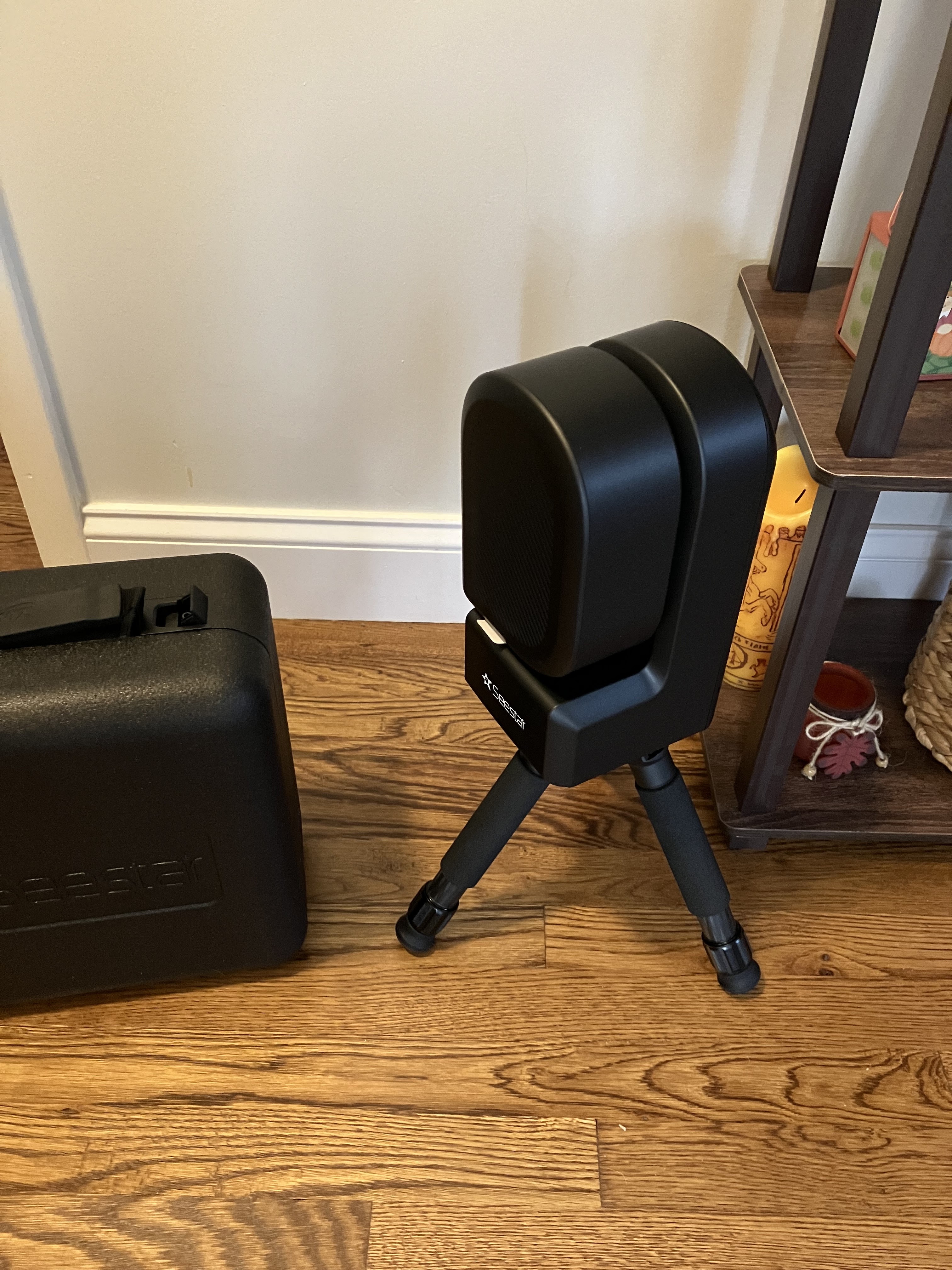
The Seestar S50 weighs only 2.5kg, the tripod is only 0.65kg, and the carry case is 0.6kg.

The Seestar S50 can be ordered directly from ZWO, right from their webpage, dedicated to the Seestar S50. It may also be ordered from many different telescope dealers online - So you can try some of the places where you normally order your telescope/astronomy equipment from.

The Seestar S50 - Removing the product box from the shipping box.


The Seestar S50 shares many features with other smart telescopes, such as:
  • It's small and compact.
  • It's controlled by your smartphone (or tablet) / Android or iPhone based.
  • Object GOTO ability / and Automatic star tracking.
  • Automatic stacking of your images from space.
  • Ability to do daytime photography (and video).
  • Comes with built in rechargeable battery. For comparison, The Dwarf II's (rechargeable) batteries are removable.
In the case of The Seestar S50 - The memory for storage of photos, is built in memory, of 64GB.

 
Additional technical specifications include:
  • A resolution of 2.1 Megapixels
  • Pixel size of 2.9um
  • A 50mm apochromatic lens aperture, @F/5
  • A 250mm focal length refractor
  • Utilizing a Sony IMX462 sensor chip


The Seestar S50 in its carry case.


The Seestar S50 sports a very slick design. It has a nice futuristic look to it, molded in black and dark gray. I find it very cool looking!


I am almost reluctant to describe how easy it is to use this smart telescope. Simply because sometimes, if something is very easy to use, it may not be taken as seriously as it should. Many people have a tendency to equate complexity, and difficulty of use, with something that is comprehensive and effective. 
So there’s a bit of a paradox here, the Seestar S50 is indeed very easy to use, however, the results it produces are very impressive:

NGC 7789  - Also known as Caroline‘s Rose named after Caroline Herschel (William Herschel‘s sister)

NGC 281 - Also known as the Pac-Man nebula.

NGC 2175 - The Monkey Head Nebula


I happen to like the blue Seestar banner on the bottom of the resulting photos. The Seestar S50's operating software is very advanced.

When it comes to who I would recommend this product for, the answer is: Anyone! Anyone, ranging in age from a (patient) teenager to someone of advanced age. Why?
Because operating the Seestar S50 couldn’t be any simpler – It only requires the main unit to be attached to the included tripod. The tripod legs opened, and the telescope placed on a flat, level surface. 
After which, you power the unit on - by holding and pressing the power button for a few seconds. The unit powers on with an audible beep, and the red and amber LEDs illuminate, indicating that the unit is powered on. 

The only section which may require a bit of dexterity (or "skill"), is the navigation of the Seestar software. This software is an astronomy/planetarium-like application. 

I may be going out on a limb here, but if a person already has an interest in astronomy, there’s a very good chance, that they will feel at home, navigating this easy to use software. I've found the software to be very intuitive to use.

The only thing required of the end-user, in essence, is to simply select what celestial objects they would like to have the Seestar S50 photograph. I hardly think that the entire system could possibly be made any easier to use.

The Seestar S50 smart telescope, would be well suited for anyone who enjoys, or is interested in the night sky. 
It would be fitting for anyone, ranging from being simply intrigued by the night sky, and especially deep sky objects – to someone who always wanted to take photographs of deep sky objects, but wasn't sure how they'd begin.
This runs the gamut to someone who has previously tried Widefield Astrophotography, or conventional Astrophotography.

This smart telescope would be well suited for anyone who is fascinated with the subject of astronomy. It would be well-suited for anyone who has owned a telescope in the past, and has dabbled in the hobby of amateur astronomy. 
I contend that those who have enjoyed conventional Astrophotography in the past, will really be blown away by both its simplicity and raw capability. And by this, I’m referring to the outstanding results which this unit produces. 

M27 - The Dumbbell Nebula
(Some minor post processing)


M13 - The Hercules Star Cluster
(cropped and post processed)


NGC 7635 - Also known as The Bubble Nebula
(only very minor post processing)


The following, could be considered my version of a Quick Start guide:
(although there's nothing wrong with the one provided)
  • Open the case, remove the Seestar S50 unit and plug it in via the provided USB cable, to begin charging it’s internal battery.
  • While waiting for the unit to charge, you can download and install the Seestar software on your smart phone.
  • When the unit is fully charged, as indicated by the red LEDs, it’s ready to begin taking images of objects in the night sky.
  • Again, the Seestar S50 excels at capturing images of deep sky objects (referred to as DSO’s).
  • You launch the smart phone app, connect to the Seestar S50 (This is via Wi-Fi) and you’re ready to select your first object to begin imaging.
No, I didn’t forget anything - those are all the steps.

Things like Polar alignment. Something which is a must, when doing conventional astrophotography don’t exist when using The Seestar S50. 
Many astrophotographers (myself included) are not fond of polar aligning a set-up. Depending on your equipment, it can be quite annoying. As evidenced by the existence of so many funny memes on the subject!

Things like:
  • (1.) Polar alignment - Not only is it not needed, but it cannot even be done! 
  • (2.) Having to take Calibration frames: Darks, Biases, and Flat frames - again, not required, and also not possible (practically speaking).
  • (3.) Having an autoguider to purchase, and then worry about.
  • (4.) Having to wait until the next day (typically) to sort through, organize, and stack your frames.
  • (5.) Stacking and post-processing "your data" - this necessitates being in front of a computer screen, for substantial lengths of time (always my least favourite part).

I found the GoTo system and pointing (finding) accuracy to be excellent!


NGC 2237 (aka Caldwell 50) - The Rosette Nebula 


Pros:
  • Requires almost zero prior knowledge of astrophotography. 
  • Features an intuitive planetarium-like software, enabling the user to explore & select objects to photograph.
  • Is rated to continue operating down to a temperature of -15℃
  • Has a built-in dew heater, which is easily turned on & off (via phone).
  • Features a built-in Duo Band nebula filter (which is amazing!). 
  • It may be used to photograph the Sun, utilising the (included) Solar Filter.
  • It may also be used for daytime/terrestrial (wildlife) photography.
  • The software gives you the ability, to easily join a worldwide network of S50 owners: Enabling you to share your "works" and "Like" other's. Like a "Facebook for astrophotographers" - Neat!

Cons:
  • Cannot enter Right ascension / Declination coordinates (for unlisted objects).
  • Exposures are "locked-in" at 10 seconds each (end user cannot [currently] modify).
  • Lower Megapixel resolution than The Dwarf II (2.xMP vs 8.xMP on Dwarf II).
  • There is currently a bit of a wait, after you order a Seestar S50 (they are still catching up on back orders, etc.). The Dwarf II may be had without delay.
I have a feeling I'll be revisiting the subject of smart telescopes on this blog again, in the near future. Believe it or not, there are some fundamental (yet simultaneously amazing) topics, which may still need to be discussed:

Like how these smart telescopes are changing the way many people enjoy the hobby of amatuer astronomy now... Astrophotography, to be more specific. 

Until next time,
Clear skies!